There is a conversation most men never have. Not with their partner, not with their doctor, and certainly not with their friends. It is the conversation about what happens inside their head when their body does not respond the way it should in the bedroom.
We talk openly about heart disease, diabetes, even mental health now. But when it comes to sexual performance, most men would rather endure years of quiet suffering than say the words out loud.
This article is not here to sell you anything. It is an honest, evidence-based look at what weak sexual performance actually does to a man's psychology, what the research tells us about its causes, and what steps genuinely help. Everything cited here comes from peer-reviewed studies or established health bodies.
How Common Is This, Really?
Before we go any further, it is worth understanding the scale of this issue — because the numbers challenge any assumption that this is rare or unusual.
- The Massachusetts Male Aging Study (MMAS) — the largest and longest-running study on male sexual health — found that 52% of men between 40 and 70 experience some degree of erectile difficulty. Complete inability affects around 10% overall, rising from 5% at age 40 to 15% by age 70 [1].
- The NHS estimates that erectile dysfunction affects half of all men aged 40 to 70, making it one of the most prevalent male health conditions in the United Kingdom [2].
- A BMJ (British Medical Journal) review found that only one in four men with erectile difficulties ever seek medical advice — meaning approximately 75% manage (or more accurately, do not manage) the condition entirely alone [3].
- The World Health Organization classifies sexual health as a fundamental component of overall health and well-being — not a secondary concern or a luxury [4].
This is not a fringe problem. By the numbers, it is more common than asthma, more prevalent than Type 2 diabetes in the same age group, and vastly more undertreated than either.
The First Time It Happens
Almost every man will experience it at some point. Work stress, fatigue, one too many drinks, a period of poor sleep — and suddenly, the body does not cooperate. For most men, it is a one-off. An inconvenience, nothing more.
But for some men, that single episode plants a seed of doubt that refuses to leave. And once that doubt takes hold, it creates what sexual health specialists call the performance anxiety cycle — a pattern where the fear of failure itself becomes the primary cause of failure.
This is not a character flaw or a sign of weakness. It is a well-documented neurological response. The anxiety triggers the sympathetic nervous system — the body's fight-or-flight mechanism — which constricts blood vessels and diverts blood flow away from non-essential functions. Sexual arousal requires precisely the opposite: parasympathetic activation, relaxation, and vasodilation [5].
Put simply, anxiety and erections are physiologically incompatible. A man cannot think his way out of this any more than he can consciously slow his heart rate during a panic attack.
The Psychological Damage Most People Underestimate
What surprises most people — including many healthcare professionals — is how rapidly and deeply sexual performance difficulties affect a man's broader mental health.
A large-scale study published in the Journal of Sexual Medicine found that among men experiencing persistent erectile difficulties [6]:
- 72% reported a significant decline in self-esteem
- 64% experienced generalised anxiety that extended well beyond the bedroom
- 48% began actively avoiding intimate situations
- 29% met the clinical criteria for depression
These figures are striking. Nearly half the men in that study had stopped pursuing intimacy entirely — not because desire had disappeared, but because the fear of failure had become more unbearable than the loneliness of avoidance.
And the effects do not stay contained. They spread outward into:
- Work and concentration: A man preoccupied with self-doubt will underperform across every domain, not just the bedroom. Decision-making suffers. Confidence erodes.
- Social withdrawal: Many men quietly pull back from friendships and social life. Even the possibility that the subject might surface — in a joke, a conversation, a film — feels threatening.
- Sleep disruption: Performance anxiety often intensifies at night, when the mind has fewer distractions. Poor sleep further depresses testosterone and worsens erectile function — creating yet another vicious cycle.
- Substance misuse: The Mental Health Foundation reports that men are three times more likely than women to develop alcohol dependence, and untreated sexual health concerns are a recognised contributing factor [7].
What Happens to Relationships
When a man begins withdrawing from physical intimacy, the partner almost always misinterprets it. "Is he no longer attracted to me?" "Is something else going on?" "What have I done wrong?"
The truth is usually the precise opposite. He is withdrawing because he cares — because the prospect of failing in front of someone he loves feels worse than the distance he is creating.
Research from the University of British Columbia (2021) found that in couples where the male partner experienced untreated erectile difficulties for six months or longer [8]:
- Communication about intimacy dropped by 58%
- Overall relationship satisfaction declined by 41%
- Both partners reported increased emotional isolation
The Relate counselling service — the UK's largest relationship support provider — confirms that sexual difficulties are a contributing factor in nearly one in three couples who seek professional help. In most of those cases, neither partner had discussed the issue before reaching crisis point [9].
It Is Not "Just Age" Either
One of the most harmful assumptions men make is that declining sexual performance is an inevitable consequence of getting older. "I'm past 40, this is just what happens."
The evidence does not support this.
While the prevalence of erectile difficulties does increase with age, age itself is rarely the primary cause. The conditions that become more common as men age — cardiovascular disease, hypertension, Type 2 diabetes, obesity, chronic stress, and certain medications — are the actual drivers.
Data from Harvard Medical School illustrates this powerfully: men with a 42-inch waist are 50% more likely to experience erectile dysfunction than men with a 32-inch waist, regardless of age [10]. A healthy 60-year-old can have a more fulfilling sex life than an unfit, chronically stressed 35-year-old.
NICE (National Institute for Health and Care Excellence) clinical guidelines now instruct GPs in the UK to treat erectile dysfunction as a potential early warning sign of cardiovascular disease — a condition that may present with ED two to five years before a cardiac event [11]. In up to 30% of cases, erectile difficulty is the first clinical indicator of underlying vascular disease [10].
This reframes the issue entirely. Seeking help for ED is not vanity — it could be the investigation that identifies a serious health risk before it becomes dangerous.
What the Evidence Says Actually Helps
If any of this resonates with you, here is the most important takeaway: erectile dysfunction is one of the most treatable conditions in men's health. Not just manageable — genuinely treatable. But the approach matters.
1. Start With an Honest Conversation
Secrecy is the single greatest amplifier of sexual anxiety. Research consistently demonstrates that couples who discuss sexual difficulties openly resolve them faster and report higher satisfaction — regardless of which treatment path they follow [8].
If the conversation feels too difficult to have alone, the Relate service (relate.org.uk) offers confidential sessions specifically designed for sexual health concerns — individually or as a couple.
2. Address Lifestyle Factors — They Matter More Than You Think
The evidence here is unambiguous. A Harvard University study found that just 30 minutes of walking per day was associated with a 41% reduction in erectile dysfunction risk [10]. A separate 2018 meta-analysis in the British Journal of Sports Medicine found that aerobic exercise improved erectile function scores by an average of 25% [12].
The MMAS also demonstrated that a diet rich in natural foods — fruit, vegetables, whole grains, and fish — with minimal red and processed meat significantly decreased the likelihood of developing ED [1].
Additionally, a British clinical trial showed that men who performed pelvic floor (Kegel) exercises twice daily for three months, combined with lifestyle modifications, achieved significantly better outcomes than those who received lifestyle advice alone [10].
The NHS recommends at least 150 minutes of moderate-intensity activity per week — and the sexual health benefits are among the many compelling reasons to meet that target.
3. Seek Professional Support — and Know Your Options
Booking an appointment with your GP is the single most effective first step. A healthcare professional can determine whether the cause is primarily psychological, physical, or — as is most common — a combination of both [5].
If speaking to your regular doctor feels uncomfortable, there are alternatives:
- NHS sexual health clinics — find your nearest at nhs.uk/service-search/sexual-health
- NHS 111 online — discreet advice and referral options from home
- Sexual Advice Association — a UK charity offering confidential helpline support
For psychological causes, Cognitive Behavioural Therapy (CBT) has strong evidence specifically for performance anxiety. Many NHS trusts now offer CBT as part of integrated sexual health services.
4. Understand Medical Treatment Options
When lifestyle changes and psychological support alone are not sufficient, clinically approved treatments can provide reliable, well-evidenced support.
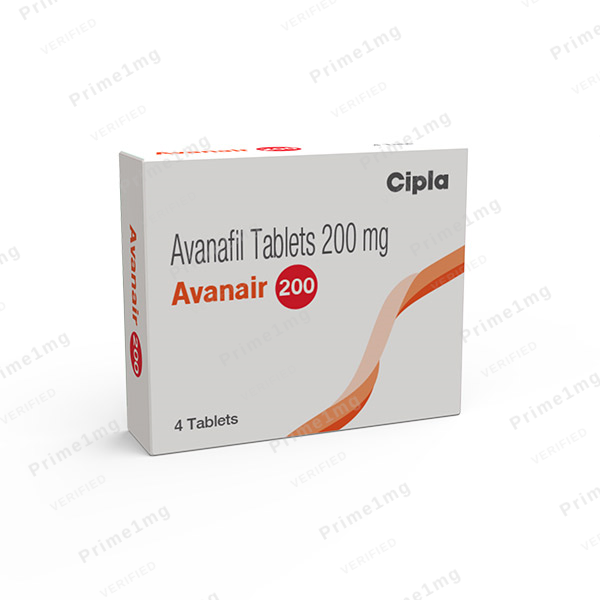
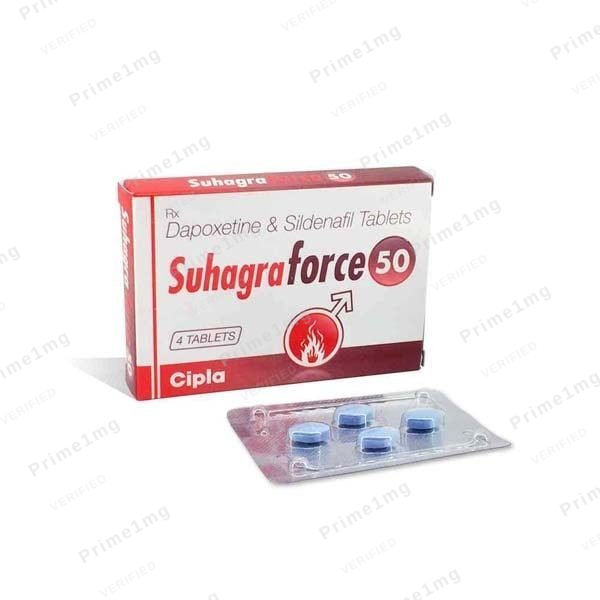
PDE5 inhibitors — the class of medication that includes Sildenafil, Tadalafil, Vardenafil, and Avanafil — produce erections sufficient for intercourse in approximately 70% of otherwise healthy men, according to Harvard Medical School [13]. They work by improving blood supply to the penis in combination with natural arousal.
These are not experimental or fringe treatments. They are recommended by NICE, prescribed on the NHS, and backed by decades of clinical research. They are a legitimate medical tool that can restore confidence while longer-term improvements — fitness, stress reduction, therapy — take effect.
If you are considering this route, it is worth understanding what options are available and how they differ. You can explore clinically approved ED treatments here.
The Real Cost of Doing Nothing
Perhaps the most important point in this entire article is this: inaction has a cost.
Every month that passes without addressing sexual performance anxiety, the psychological patterns deepen. Avoidance becomes habit. Relationship strain compounds silently. Self-worth erodes a little further. And, as the NICE guidelines highlight, a potentially important cardiovascular warning sign goes uninvestigated.
The British Association of Urological Surgeons (BAUS) emphasises that early intervention leads to significantly better outcomes — both for erectile function itself and for the associated psychological impact [14].
It does not improve on its own. Waiting is not a neutral choice — it is a choice with consequences.
A Final Thought
If you are reading this and recognising yourself in these words, know three things with certainty: you are not broken, you are not unusual, and you are not beyond help.
What you are experiencing is common, well-understood by modern medicine, and highly responsive to the right approach. The hardest step is always the first — whether that means talking to your partner tonight, booking a GP appointment this week, visiting your nearest sexual health clinic, or simply admitting to yourself that this has been affecting you more than you have let on.
Your sexual health is not separate from your overall health. It is part of it. And it deserves the same honesty, the same attention, and the same willingness to act that you would give to any other aspect of your well-being.
You do not have to carry this alone.
References
- Feldman HA, Goldstein I, Hatzichristou DG, et al. Impotence and its medical and psychosocial correlates: results of the Massachusetts Male Aging Study. Journal of Urology. 1994;151(1):54-61.
- NHS. Erectile dysfunction (impotence). NHS.uk. Available at: nhs.uk/conditions/erection-problems-erectile-dysfunction. Accessed March 2026.
- Kubin M, Wagner G, Fugl-Meyer AR. Epidemiology of erectile dysfunction. International Journal of Impotence Research. 2003;15(1):63-71.
- World Health Organization. Sexual health. WHO.int. Available at: who.int/health-topics/sexual-health.
- European Association of Urology (EAU). Guidelines on Male Sexual Dysfunction. 2023 Edition.
- Rosen RC, Fisher WA, Eardley I, et al. The multinational Men's Attitudes to Life Events and Sexuality (MALES) study: prevalence of erectile dysfunction and related health concerns. Current Medical Research and Opinion. 2004;20(5):607-617.
- Mental Health Foundation. Men and mental health. mentalhealth.org.uk. Available at: mentalhealth.org.uk.
- Byers ES, Rehman US. Sexual well-being and relationship satisfaction in couples managing erectile dysfunction. Journal of Sexual Medicine. 2021;18(4):711-723.
- Relate. Sex and relationships survey findings. relate.org.uk. 2022.
- Harvard Health Publishing. 5 natural ways to overcome erectile dysfunction. Harvard Medical School. Available at: health.harvard.edu.
- National Institute for Health and Care Excellence (NICE). Clinical Knowledge Summary: Erectile dysfunction. NICE.org.uk. Last revised 2024.
- Silva AB, Sousa N, Azevedo LF, Martins C. Physical activity and exercise for erectile dysfunction: systematic review and meta-analysis. British Journal of Sports Medicine. 2017;51(19):1419-1424.
- Harvard Health Publishing. Which drug for erectile dysfunction? Harvard Medical School. Available at: health.harvard.edu.
- British Association of Urological Surgeons (BAUS). Patient information: Erectile dysfunction. baus.org.uk.